Why Paper Fibres Fray at the Cut Edge
Why paper fibres fray at the cut edge, and how to tell whether grain, blade condition or paper texture is leaving loose fibres behind.
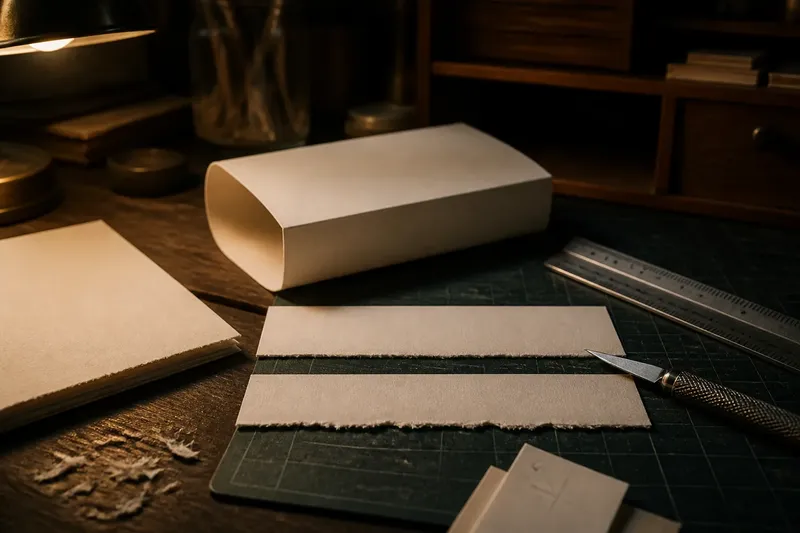
Why paper fibres fray at the cut edge is a question that often comes up when a fresh cut looks feathered rather than clean. Grain can influence how fibres respond, but the blade, paper surface and cutting method matter too. A small, controlled comparison helps separate these clues.
Imagine you are cutting a paper sleeve from cartridge paper and find a fringe of fibres along one side. Before changing the layout, set aside an offcut, check the blade and compare a short cut in each grain direction. The appearance of those edges can help you decide whether the sheet’s direction is relevant or the tool needs attention.
How does paper grain affect a cut edge?
Paper is a mat of fibres pressed together. During manufacture, more fibres tend to align in one direction than another; that preferred direction is called the grain. It is not usually visible as a set of lines on a plain sheet.
Grain is easier to notice in a fold or tear than in a clean cut. A fold parallel to the grain often bends with less resistance, while a fold across it may feel stiffer or show more cracking. A tear may travel more readily along the grain and expose loose ends. These are tendencies, not rules: paper composition, thickness, surface treatment and moisture also affect behaviour.
A blade cuts across fibres rather than separating them in the uneven way a tear does. With a sharp blade and stable paper, the edge may look clean in either direction. Grain can still influence how the sheet responds, but a ragged cut alone does not identify its cause.
What makes cut paper fibres look ragged?
Several things can leave loose fibre ends at a cut:
- A blunt or dirty blade: it may drag or pull fibres instead of severing them cleanly.
- Paper that shifts: movement against the straightedge can disturb the cut line.
- A soft or textured sheet: its surface may naturally show uneven fibre ends.
- A coated surface: the coating and the paper beneath it may separate differently at the edge.
- Cutting direction: grain may affect how fibres respond, though it is only one possible influence.
Look at the edge in good light. A few lifted fibres at the surface can look similar whether they came from the paper’s texture or from a blade that dragged. Compare against a fresh cut on scrap before settling on an explanation.
How can you compare cuts with and across the grain?
Use a spare strip from the same sheet, a clean craft knife, a straightedge and a cutting mat. Keep fingers clear of the blade’s path, and follow the tool maker’s handling guidance. Make the two test cuts with comparable pressure and length, changing only their direction relative to the sheet.
- If one cut is tidier and the other shows more lifted fibres, mark their directions on the offcut; grain may be affecting the result, so try orienting the final piece differently.
- If both cuts look similarly ragged, replace or clean the blade as its instructions allow, then compare a new cut; if it remains rough, consider the paper’s surface or texture instead.
- If the paper shifts during either cut, secure it with a suitable straightedge and make a fresh comparison; if it still moves, choose a more stable cutting setup.
- If the test cuts look clean but the project edge does not, inspect how the full sheet is supported; if support is sound, repeat the cut on scrap using the same technique before changing the design.
- If the paper is coated or heavily textured, compare the edge with an uncoated or smoother offcut if available; if the texture accounts for the fringe, decide whether that finish suits the project.
- If you cannot spare an offcut, choose a hidden corner only if trimming it will not affect the finished piece; otherwise, leave the sheet intact and use a separate sample of the same paper.
A gentle bend or small tear in two directions can help identify the grain before you label the cut tests. Mark the direction that bends more easily on the offcut. Treat that as a clue rather than a diagnosis: humidity, storage and surface treatment can affect how a sheet behaves.
What do the test cuts tell you?
Does a cut parallel to the grain always look cleaner?
No. A sharp blade can make a clean cut in either direction, and paper texture or handling may outweigh grain. Compare similar cuts on scrap before deciding which direction works better for your sheet.
Can a ragged cut prove the blade is blunt?
No. A blunt blade is one possible cause, alongside paper movement, surface texture and grain. A fresh cut on scrap with a clean, sharp blade can help you distinguish them.
Why can a tear show grain more clearly than a cut?
A tear separates fibres unevenly, exposing loose ends and changes in the path. A sharp blade severs fibres more directly, so the cut edge may conceal their alignment.
Should the whole project follow the grain?
Not necessarily. Grain is one design consideration; the shape and use of the piece may call for a different orientation. If the cut edge stays rough in both directions, check the blade and support before changing the layout.
How does a cut comparison guide the next choice?
Say you have an offcut of cartridge paper, a craft knife and a straightedge, and the first sleeve blank has a feathered edge. You make one short cut along the direction that a gentle bend suggests is parallel to the grain, then another across it, using the same blade and support. In this invented situation, the first edge looks cleaner while the second has more lifted fibres. You mark the easier-cutting direction on the offcut and orient the next blank to use it for the visible edge; if the fold layout would then become awkward, you keep the original layout and address the blade or support instead. The result is a choice informed by the actual edge, not a rule that every cut must follow the grain.
When paper fibres fray at the cut edge, compare the two directions on scrap, then check whether the sheet moved and whether the blade is clean and sharp. If the same surface fringe remains in both directions, it may be part of the paper’s character rather than a problem grain can solve. Keeping that distinction in mind makes the next cut easier to plan.